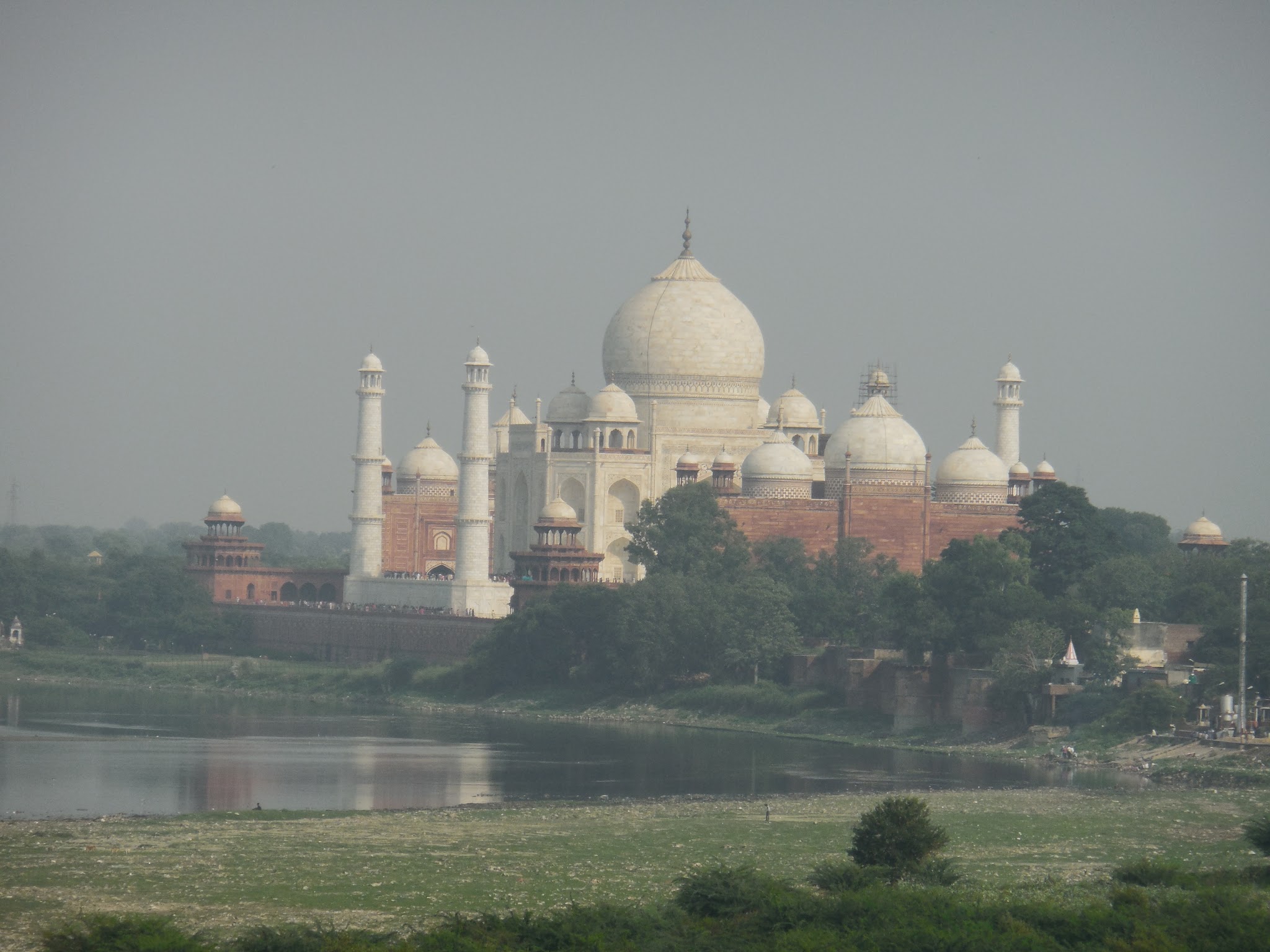
The Taj Mahal is one of the most famous monuments in India and is very popular with tourists. It was built in the 17th century and is regarded as the acme of Mughal architecture.
When visiting the Taj Mahal for the first time, it struck me that the tilings used in different parts of the monument were distinct both in terms of the patterns and the material used. This was made possible partly due to the fact that the rush was relatively heavy, and the slow walk provided ample time to ponder over not only the imposing main structure and its ornate designs but also the ground underneath. The latter often misses our attention but tends to have its own elegance and symmetries.
Although a rough idea of the geometry can be obtained just by looking at the tiling patterns, I though it would be worthwhile to actually draw them somewhat more accurately and get a more precise and accurate idea of the exact shapes and symmetries involved. The drawings provided here were created using draw.io and the xml source file can be viewed here.
Some of the interesting patterns are described in detail below. All the four tessellations mentioned here are polygonal ones involving both regular and irregular as well as both convex and concave polygons. The colors are those of white marble and sandstone (reddish and yellowish). In the drawings, however, they are shown as white and reddish shades respectively for simplicity.
Pattern 1: On the long external approach walkway leading to the main structure
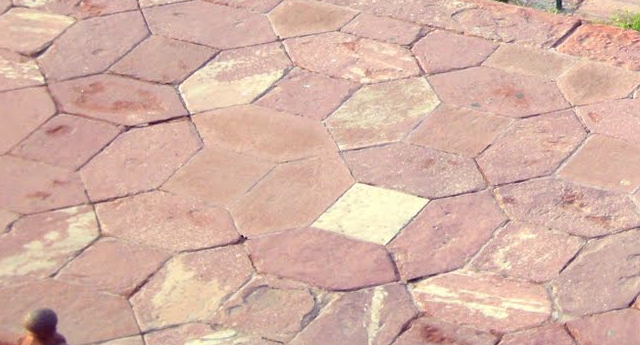
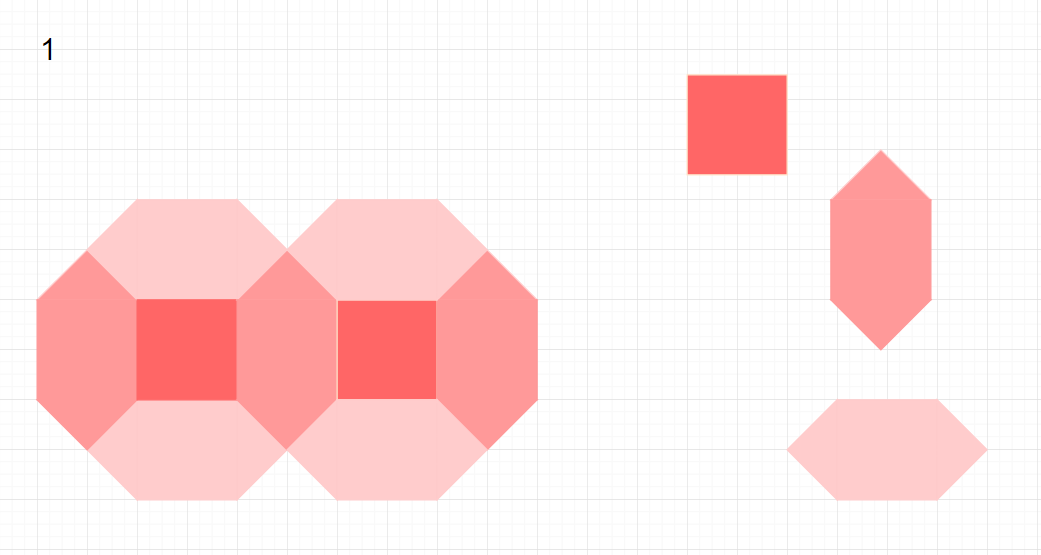
Two types of tiles are used :-
i) square
ii) irregular convex hexagon
Four surrounding hexagons and enclosed square combine to form an irregular convex hexagon. And these bigger hexagons overlap with neighboring ones by sharing a smaller hexagon with each.
Pattern 2: Sides of the lower platform of the main structure
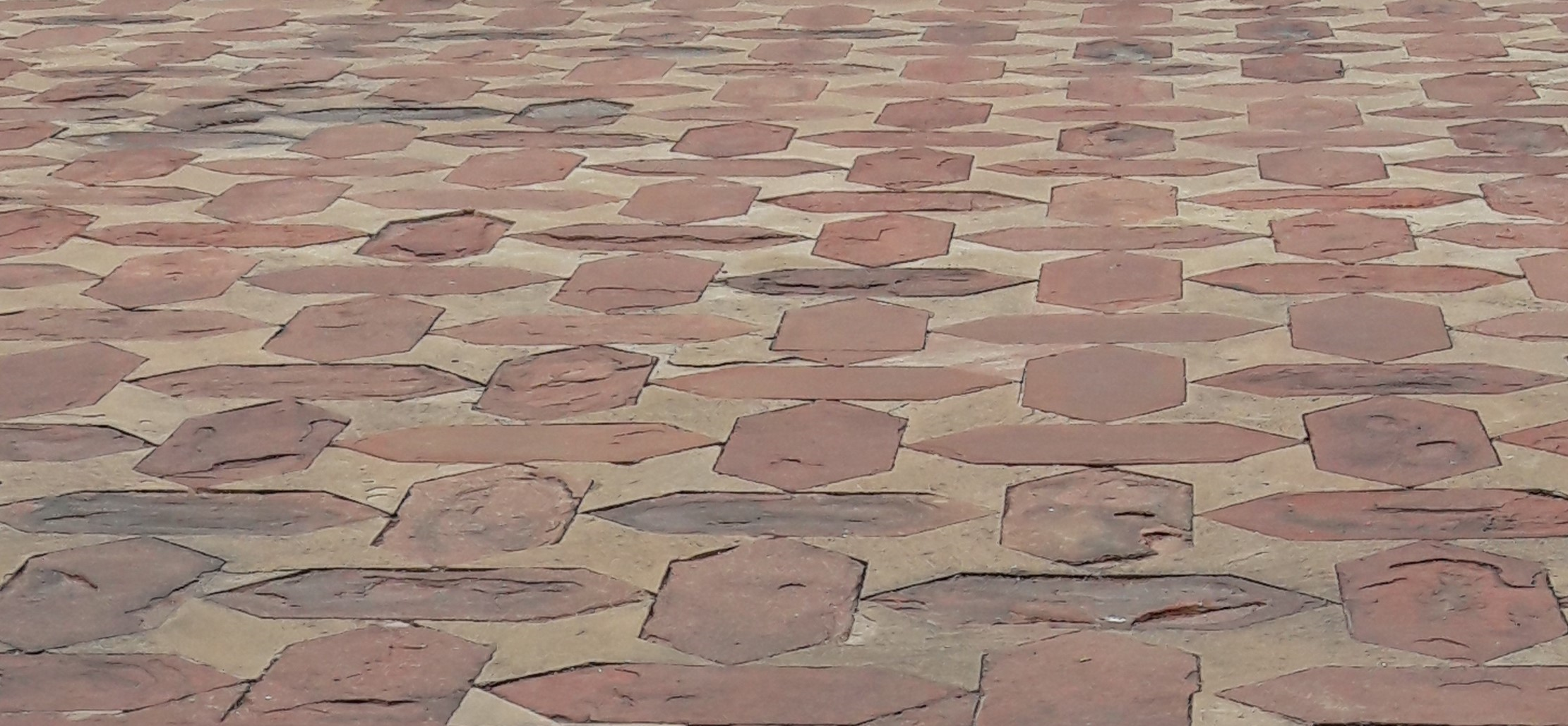
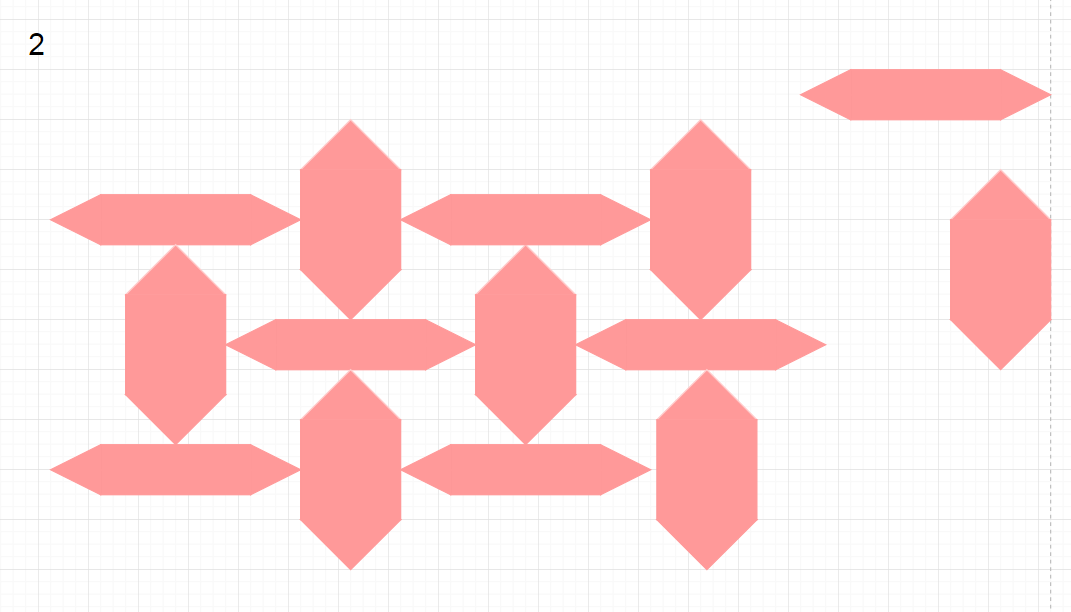
Three types of tiles are used:-
i) thin convex irrelgular hexagon
ii) thick convex irregular hexagon
iii) concave irregular octagon (star-shaped)
The octagon is shown white here but in reality is just a slightly yellowish shade as shown in the photo.
Pattern 3: Central part of the lower platform of the main structure
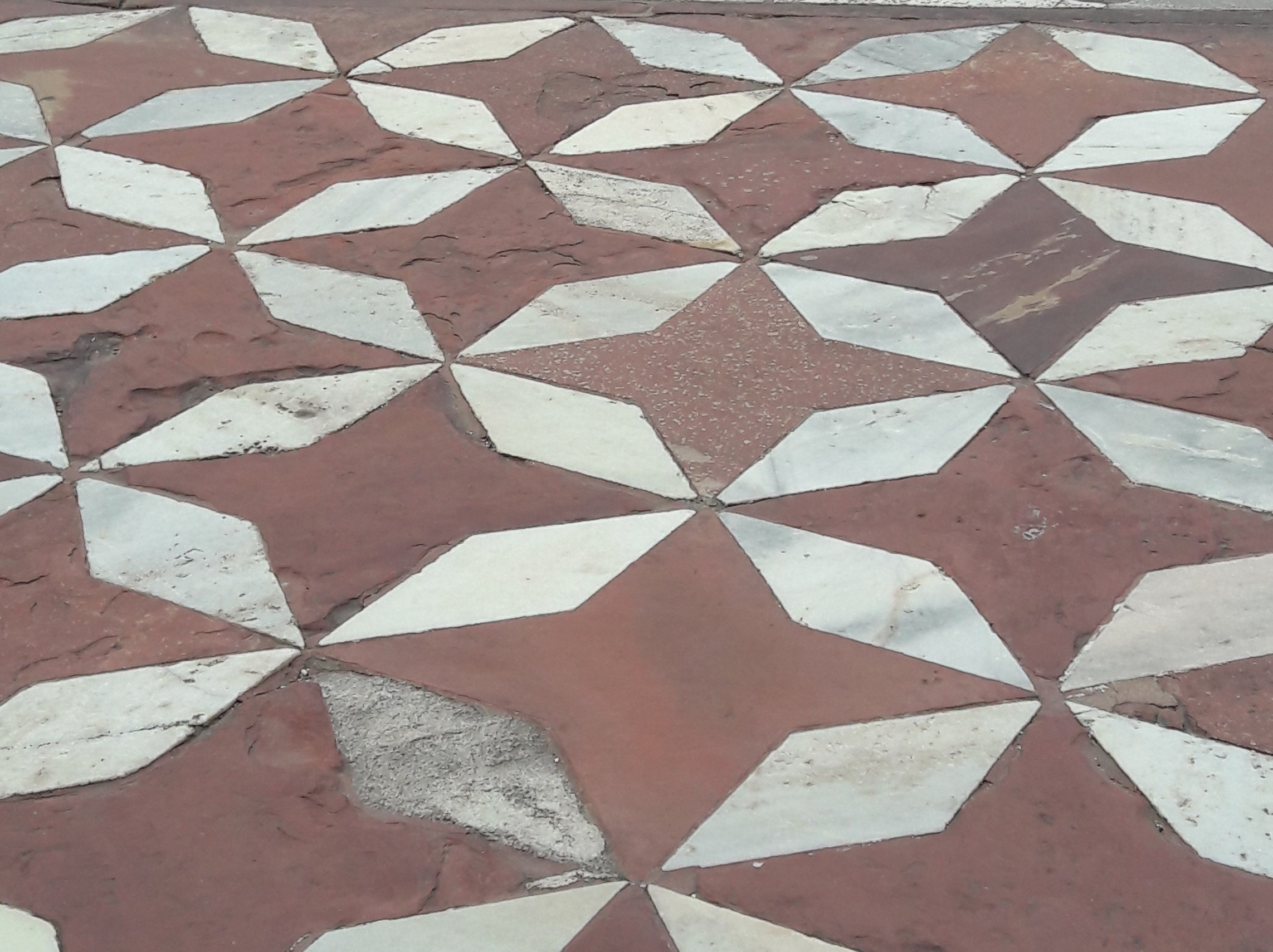
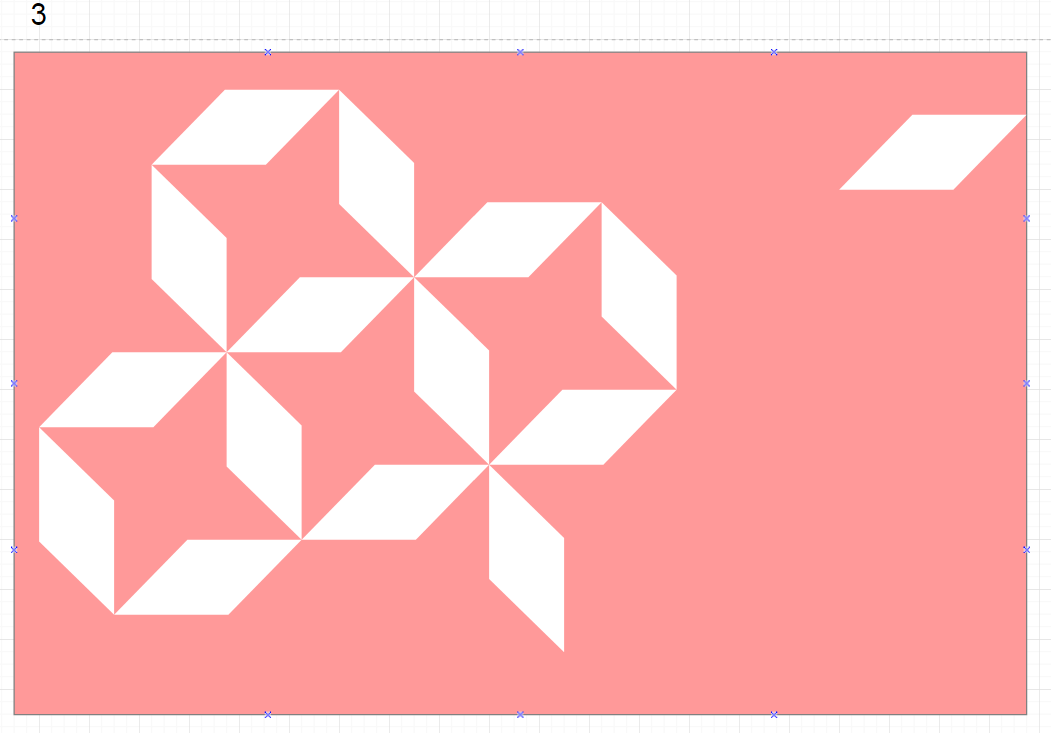
Two types of tiles are used:-
i) rhombus
ii) concave regular octagon (star-shaped)
The rhombus tiles have 45° and 135° angles. Four surrounding rhombuses and the enclosed octagon form a regular convex octagon. This is because all the interior angles are 135° and thus a regular convex octagon is formed.
Pattern 4: Within the interior of the mausoleum
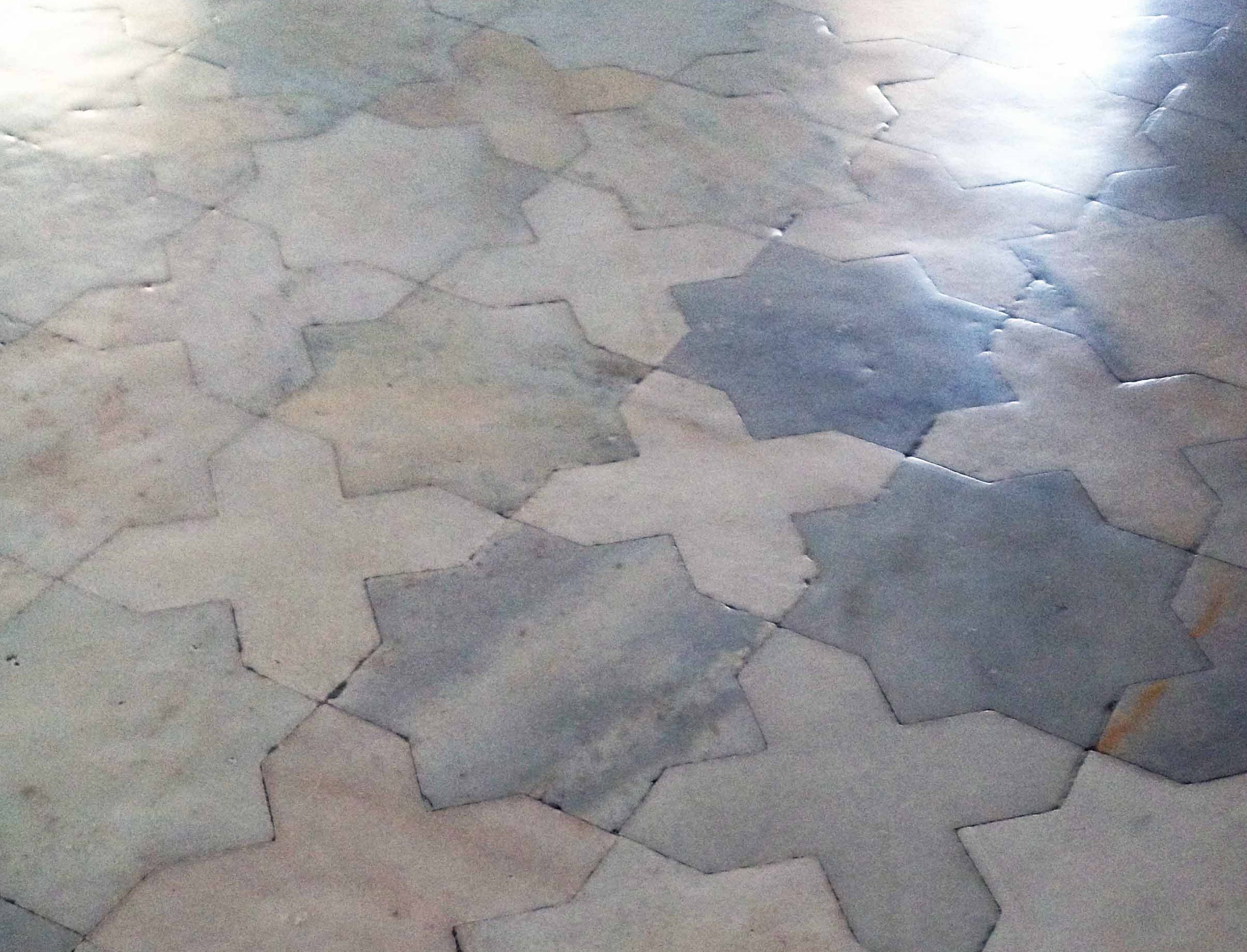
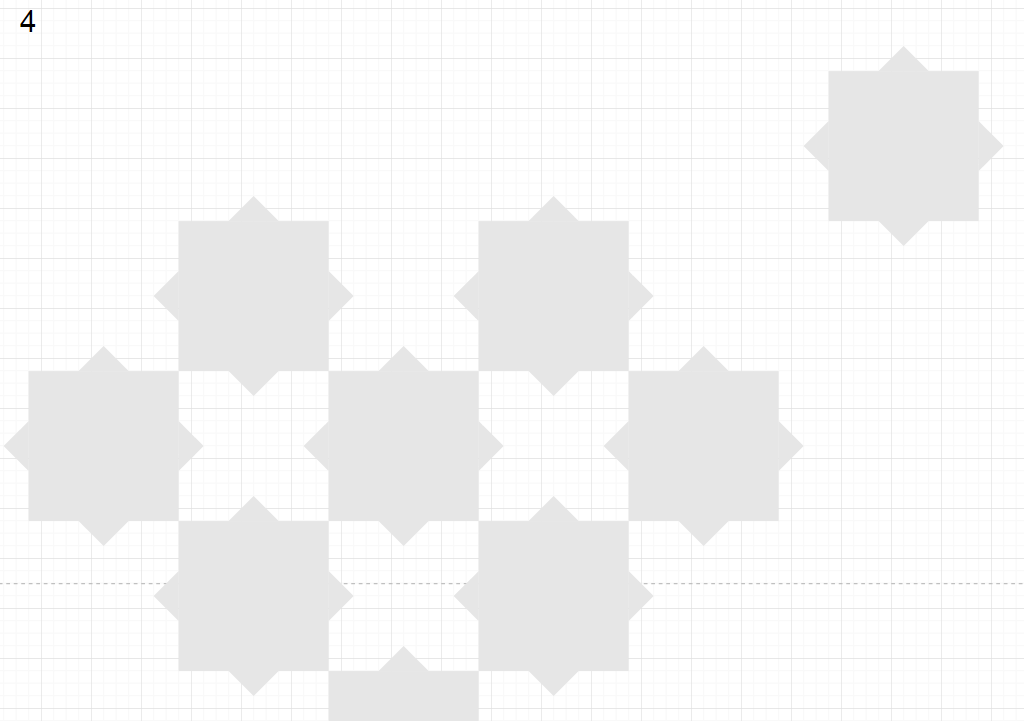
Two types of tiles are used :-
i) 16-gon convex irregular
ii) 16-gon concave irregular
Both tiles are whitish grey in reality as in the photo on the right. But in the drawing, they are shown as gray and white. The small protruding triangles in the grey tiles are right-angled isosceles ones i.e. with angles of 90° ,45° ,45°. This is achieved by keeping the height equal to half the base.
Finally, below is a view of the imposing structure as seen from the Agra Fort.